


These guys are really betting on AI replacing a lot of workers. - Geoffrey Hinton
With the holidays approaching, AI is bound to come up in dinner-table conversation.
Between bites of turkey, existential questions will start to fly:
Will AI actually replace my job?
What degree is actually worth the tuition?
Is there any point in working hard if an AI is just going to do it all anyway?
If you’re reading this with a knot in your stomach about your career, you’re not paranoid, you’re paying attention.
What’s happening in the job market is real, it’s frightening, and pretending otherwise helps no one.
But understanding it?
That gives you agency.
In November 2025, a new global survey from IDC asked 5,500 business leaders across 22 countries how AI is shaping work. [7]
These are people making decisions about budgets, talent, and long-term company direction, across almost every major industry you can think of.
Here’s the part that made me stop and reread:
66% of them are slowing entry-level hiring because of AI. [7]
Not changing. Not retraining. Not rethinking. Slowing.
3,600 out of 5,500 business leaders are actively slowing their hiring for entry roles. The entry-level knowledge worker isn’t evolving; they’re vanishing.
Last month, I became one of those 66%.
For context, I run an AI consultancy.
Business owners come to me asking if they can automate tasks or modernize their tech stack. Last month, one asked if he could replace an entire role.
While researching it, I found the employee’s LinkedIn.
I clicked his profile.
He’s my age. Early career.
We graduated the same year.
We grew up on the same internet.
We are standing on the exact same timeline,
but on opposite sides of an algorithm.
An hour later, my phone buzzed with a notification:
”Uriah viewed your profile.”
He saw me looking.
Maybe he thought I was a recruiter. Maybe he thought I was a potential connection. I still wonder.
His latest post:
“Excited to grow and learn new skills with this amazing team.”
I asked the business owner: “What’s your plan for him if we automate this?”
You already know the answer.
And so does he.
Before you continue: If you’re job hunting, in college, or employing people, share this. This is the conversation everyone’s avoiding.
Why This Is Happening
Before I show you more data, you need to understand why this is happening. Two scientific paradoxes, discovered decades ago, predicted this exact moment.
Once you understand them, every statistic you’re about to see will make perfect sense.
More importantly, you’ll be able to apply a simple test to your own career to determine your risk level.

1. Moravec’s Paradox
Roboticist Hans Moravec discovered something deeply counterintuitive:
“It is comparatively easy to make computers exhibit adult-level performance on intelligence tests or playing checkers, and difficult or impossible to give them the skills of a one-year-old when it comes to perception and mobility.”
Translation: High-level reasoning, calculus, chess, coding, requires surprisingly little computational power.
These tasks are algorithmically straightforward once you understand the rules.
Basic physical skills, walking across a messy room, folding a towel, reading facial expressions, require immense processing. They’re the result of billions of years of evolutionary refinement.
The “hard” problems for humans are easy for AI.
The “easy” problems for humans are nearly impossible for AI.
This flips everything we thought we knew. Your expensive degree teaching you advanced mathematics or software engineering?
That work is computationally easy to automate. The electrician rewiring your house or the nurse checking your vitals?
Those jobs require skills that are nearly impossible to replicate.
But it’s not just about physical movement. There’s a second paradox that protects an entirely different category of work.

2. Polanyi’s Paradox
Philosopher Michael Polanyi observed:
“We can know more than we can tell.”
Translation: Humans possess vast tacit knowledge, intuition, experience, feel, vibe, that we cannot articulate or formalize.
We know how to comfort a scared patient or navigate office politics, but we can’t write down the rules for doing it.
If you can’t articulate the rules, you can’t program them.
If you can’t program them, AI can’t do them.
This makes skills requiring human connection or judgment incredibly difficult to automate.
These two paradoxes converge on a single dividing line: physics.
If your output is a file, a document, a line of code, a financial model, a design, you’re competing with infinite supply of labor at the cost of energy.
If your work requires physical presence or human connection, if it involves touch, movement, trust, or reading the room, you’re protected by the very laws of physics and human psychology that make these tasks impossibly complex for machines.
The 50-year contract between education and employment just broke.
And here’s the proof.
What’s Actually Happening
To understand what we’re losing, we need to look at what we had.
For fifty years, the formula was simple:
Go get a degree. Learn the hard skills. Get a desk job. Be safe.
We called it the Knowledge Economy.
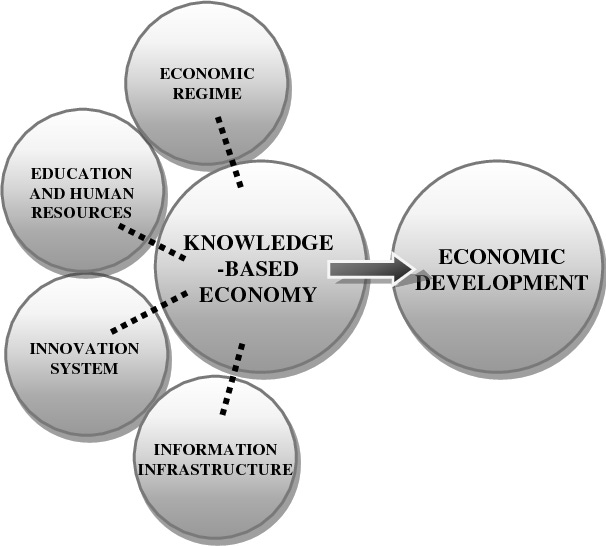
The market paid a premium for cognitive labor.
The smarter you were with a computer or tech, the more you earned.
The logic was clear: master complex tasks on a screen, and you’d never worry about job security.
Then generative AI arrived.
And everything Moravec predicted came true.
The Collapse in Numbers
Software Engineering
Entry-level software engineering postings have dropped between 43% and 60% across North America and Europe. [1]
The Indeed Hiring Lab confirms that 81% of skills in a typical software development job posting now fall into “hybrid transformation” categories, meaning AI can handle the bulk of the work. [2]
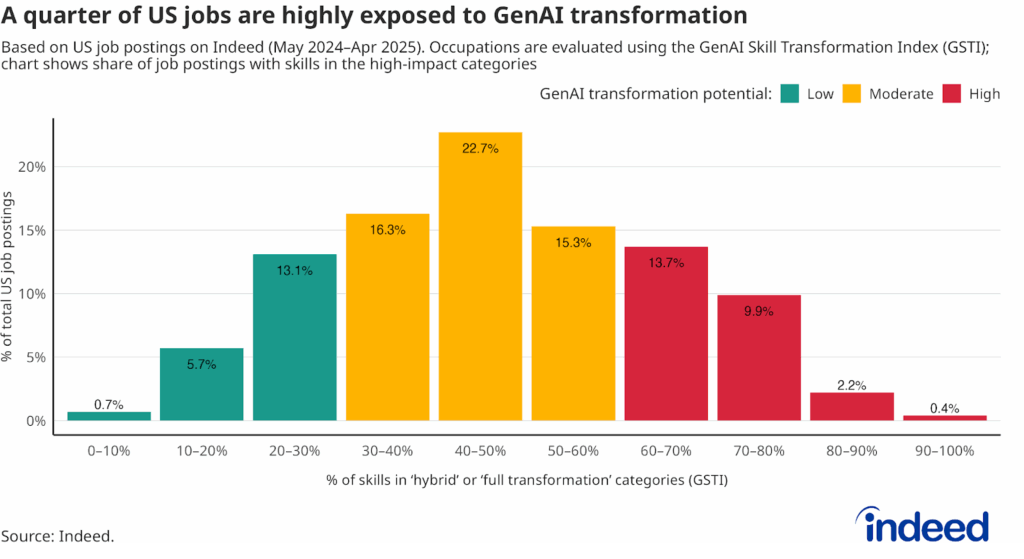
The Tech Hiring Freeze Major tech companies have cut hiring for fresh graduates by 50% compared to 2019 levels. This isn’t temporary restructuring. This is structural change. [4]
The Federal Reserve Confirmation The Federal Reserve reports that firms across industries are explicitly using AI to “curb new hiring” for entry-level positions. They are choosing attrition over backfilling. [5]
Translation: When someone quits, they’re not replacing them. They’re replacing them with software.
But not all work is collapsing. Some jobs are booming. And the pattern is exactly what the paradoxes predicted.
The Jobs That Survive
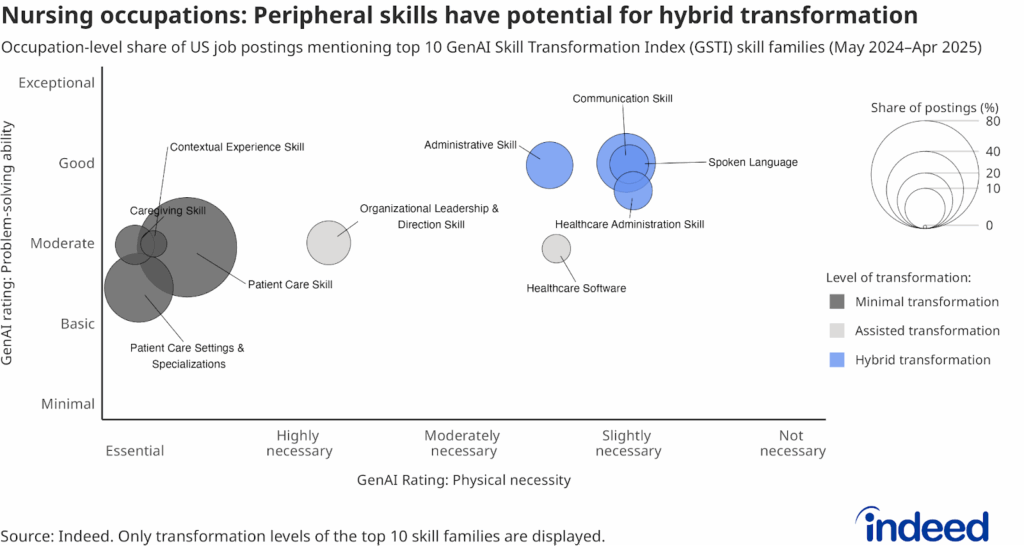
68% of nursing skills are classified as “minimal transformation” by Indeed’s analysis. Why? Because patient care is inherently physical. [2]
Moravec’s Paradox in action: Comforting a scared patient requires touch, presence, and trust. Reading vital signs requires physical coordination.
Managing an emergency room requires spatial awareness and split-second physical responses.
Nurse practitioner roles are projected to grow 40% from 2024 to 2034. [6]
Trades Construction faces labor shortages. AI cannot rewire a house, fix a burst pipe, or frame a wall.
These tasks require the exact combination of physical manipulation and real-time problem-solving that remains impossibly difficult for machines.
The electrician is more secure than the software engineer.
Physical presence wins. File production loses.
Your college counselor gave you exactly the wrong advice.
The paradoxes predicted this. The data confirms it.
What This Means for Your Career
Now that you understand the framework and have seen the evidence, the question becomes: What do you actually do about it?
Let’s apply these insights to the three questions everyone’s asking.
1. Will AI Actually Replace My Job?
Here’s the test: What do you produce?
If Your Output Is a File Documents, code, reports, designs, analyses, you’re competing with algorithms that work 24/7 for pennies. The dividing line is physics. If your work can be transmitted over the internet with no social interaction, it can be automated.
Risk level: HIGH
If Your Work Requires Physical Presence Patient care, construction, repair, installation—these are protected by the very complexity that makes humans good at them. You’re not competing with software; you’re operating in a domain where software fundamentally cannot reach.
Risk level: LOW
The Senior Exception But there’s a twist: senior experts aren’t being replaced—they’re being condensed.
Teams that needed 10 junior employees now need 1 senior professional managing AI systems. The junior roles vanish. The expert becomes an AI orchestrator, using software to accomplish what previously required an entire team.
The question isn’t whether you work with computers. It’s whether you provide judgment or just throughput.
2. What Degree Is Actually Worth the Tuition?
Short answer: Degrees that grant you legal access to physical work or carry personal liability.
The Safe Bets
Healthcare: Nursing, physical therapy, medical school—these degrees grant legal access to perform medical care. They’re protected by both regulation and physics. You cannot practice medicine without a license. You cannot provide patient care remotely.
Liability Roles: Law and Civil Engineering. We need a human to sign off on structural safety. We need a lawyer we can sue if advice is wrong.
AI can draft the contract or run the load calculations. But it cannot stake its reputation on the outcome.
It cannot carry insurance. It cannot be held accountable.
The market still needs someone whose name goes on the document.
The Risky Bets
Generic Computer Science and Business Degrees: With 66% of firms slowing entry-level hiring, traditional “learn to code” or “get your MBA” paths lead to shrinking markets. These degrees made sense when the market paid a premium for cognitive labor. But that premium just evaporated.
Unless the program teaches you to manage AI systems rather than simply use computers, it’s preparing you for jobs that won’t exist by the time you graduate.
PARENTS: Share this before your kid picks a major. The ROI calculations from 2015 are obsolete.
3. Is There Any Point in Working Hard?
Short answer: Yes, but “hard work” now means judgment, not throughput.
The Shift We used to pay for volume—how many reports you could write, how many calls you could make, how many lines of projects you could work on. That value dropped to zero because AI produces infinite volume.
We now pay for:
Liability: Someone we can hold responsible
Orchestration: Managing AI / Human systems effectively
Verification: Checking AI outputs for accuracy and appropriateness
Final Judgment: Making the call when AI can’t or shouldn’t
The New Definition of Hard Work: Hard work means becoming the person whose judgment others bet money on. Not the person who produces the most output. The person who takes responsibility for the output.
The Centaur Model The hardest-working professionals in 2030 will be “Centaurs”, humans who use AI to do the work of 10 people while applying human oversight. The human is the EQ filter of the AI system.
You don’t compete with AI.
You amplify yourself with it.
You become the expert who knows when to trust the machine and when to override it.
The market will pay a premium for people who can be trusted with high-stakes decisions, not people who can produce high volumes of low-stakes work.
How to Position Yourself
Understanding the problem is necessary. But it’s not sufficient. You need a strategy.
Four brutal truths:
If you work at your computer with low social interaction, you’re at risk.
The entry-level job market just collapsed.
Senior experts are becoming AI managers.
Your degree matters less than your skills.
If any of these hit close to home, you need to act.
Not eventually. Now.
Your Three-Part Strategy
1. Proof Over Pedigree Companies are bypassing traditional filters in search of candidates with tangible output. By sharing micro-products on GitHub or your personal site, you provide undeniable proof of your ability to create useful things with taste.
The goal is a visible history of creation. Build in public. Show your work. Demonstrate that you can take an idea from concept to deployment.
2. Learn AI Skills: Proficiency with consumer-grade AI like ChatGPT is now baseline, everyone has it.
To offer real value, you must step outside the gated walls of Mr Altman.
Focus on building AI agents.
Develop custom workflows that integrate multiple tools.
Start small, you’ll be surprised how much is possible now.
Employers want people pushing technical boundaries, not waiting for the next update.
3. Invest in the “Human Economy” As AI commoditizes technical execution, your soft skills become your economic moat. Empathy, strategic judgment, and reputation management are assets that code cannot replicate.
AI can process the data, generate the report, and draft the email. But it cannot shoulder the risk of a high-stakes decision.
It cannot read the room.
It cannot build trust over years of consistent delivery.
These are not “soft” skills.
They are the hardest skills to develop and the most valuable to possess.
Double Down on EQ
The Core Challenge
Here’s the question you must answer:
“What is the specific human value I provide that cannot be replaced by an automated process?”
If you can’t answer this clearly, you’re vulnerable.
If you can answer it and prove it, you’re irreplaceable.
The market will pay a premium for that answer.
Don’t Be Him
Remember that employee I mentioned at the beginning?
The one whose job I was asked to automate?
I was recommended a repost.
His company just announced “AI initiatives” in their Q4 report. He reposted about it:
“Proud to be part of a forward-thinking team.”
He still doesn’t know.
His manager does. The CFO does. I do.
His employer already accepted my proposal. Implementation starts in January.
He has maybe 90 days.
Don’t be him.
Don’t be the person who was “excited to learn and grow” while the exit was already being planned.
Be the person who saw this coming.
Be the person who AI can’t replace.
Be the person whose judgment is worth betting on.
The dinner table conversation is happening whether you’re ready or not.
Thank you.
Max
Sources
[1] IntuitionLabs, “AI’s Impact on Graduate Jobs: A 2025 Data Analysis” (2025).
[2] Indeed Hiring Lab, “AI at Work Report 2025: How GenAI is Rewiring the DNA of Jobs” (September 2025).
[3] Demirci, O., Hannane, J., & Zhu, X., “Who Is AI Replacing? The Impact of Generative AI on Online Freelancing Platforms,” Management Science (2024).
[4] SignalFire, “The SignalFire State of Tech Talent Report – 2025” (2025).
[5] Federal Reserve, “Beige Book” (November 2025).
[6] U.S. Bureau of Labor Statistics, “Fastest Growing Occupations: Occupational Outlook Handbook” (2024).
[7] IDC InfoBrief (commissioned by Deel), “AI at Work: The Role of AI in the Global Workforce” (November 2025).
This was a great read and very insightful. Thank you!
Great read, agree - especially with the example. 90 % are still there not realising it’s happening